
Diaphragm pumps are widely used due to their resistance to chemicals, viscous liquids, and suspended particles contained in wastewater. Their operation is based on the reciprocating motion of a rubber diaphragm, which allows liquids to be pumped without direct contact with moving parts, reducing wear and the need for frequent maintenance. These pumps are particularly effective in transferring chemical solutions, sludge, and highly viscous liquids, and provide reliable performance even under constantly changing conditions, such as changes in flow or pressure.
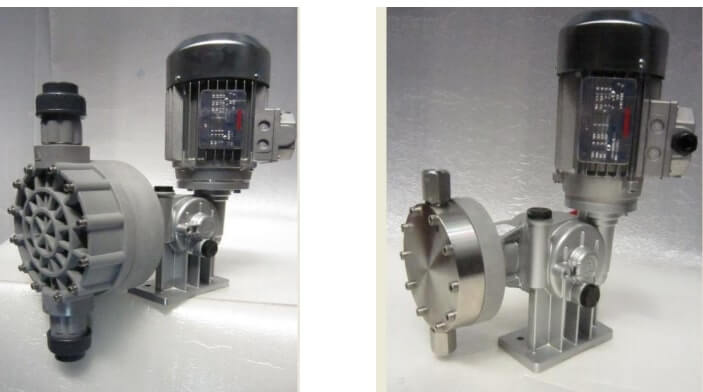
Diaphragm pumps
Piston pumps offer accurate and stable pumping of liquids, even at high pressures, providing excellent performance and reliability with minimal maintenance. They operate with the help of one or more pistons moving inside a cylinder, pushing the liquid towards the outlet pipe. This type of pump is excellent for pumping sludge, chemical solutions, and other liquids with high viscosity or suspended particles.
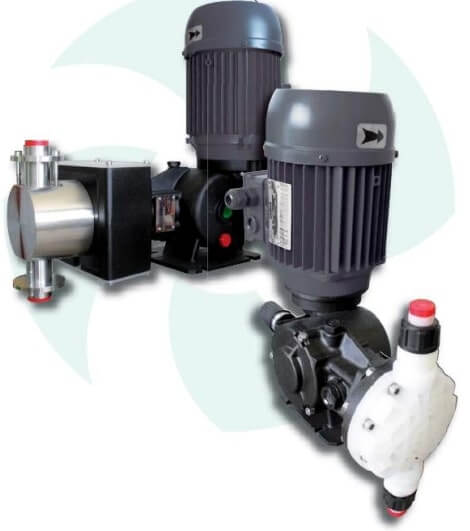
Piston pump
Peristaltic pumps provide reliable pumping of liquids with high viscosity or suspended particles. They operate by rotating a rubber tube and a roller, which compresses the liquid and transports it to the outlet. This configuration minimizes contact between the pumped liquid and the moving parts of the pump, reducing wear and the need for maintenance. They are suitable for pumping sludge, chemical solutions, and other wastewaters, offering a stable and accurate flow, even under changing pressure conditions.